5 Awesome Strapi Alternatives
 Yulei Chen
Strapi is one of the most popular open-source headless CMS platforms, letting developers build flexible APIs with a built-in content management interface. It's a solid choice for many projects — but Strapi Cloud pricing can add up fast. The free tier is limited to 500 DB entries and cold-start instances only, while the Essential plan jumps to $18/month, the Pro plan to $90/month, and the Scale plan to $450/month.
The good news? You can self-host Strapi for just €9 per month with Sliplane — one click, no server management needed.
But maybe Strapi isn't quite the right fit for your use case. Maybe you need something that wraps your existing database, integrates natively with your Next.js app, or comes with a visual editor for marketing teams. Let's look at 5 awesome alternatives!
1. Directus
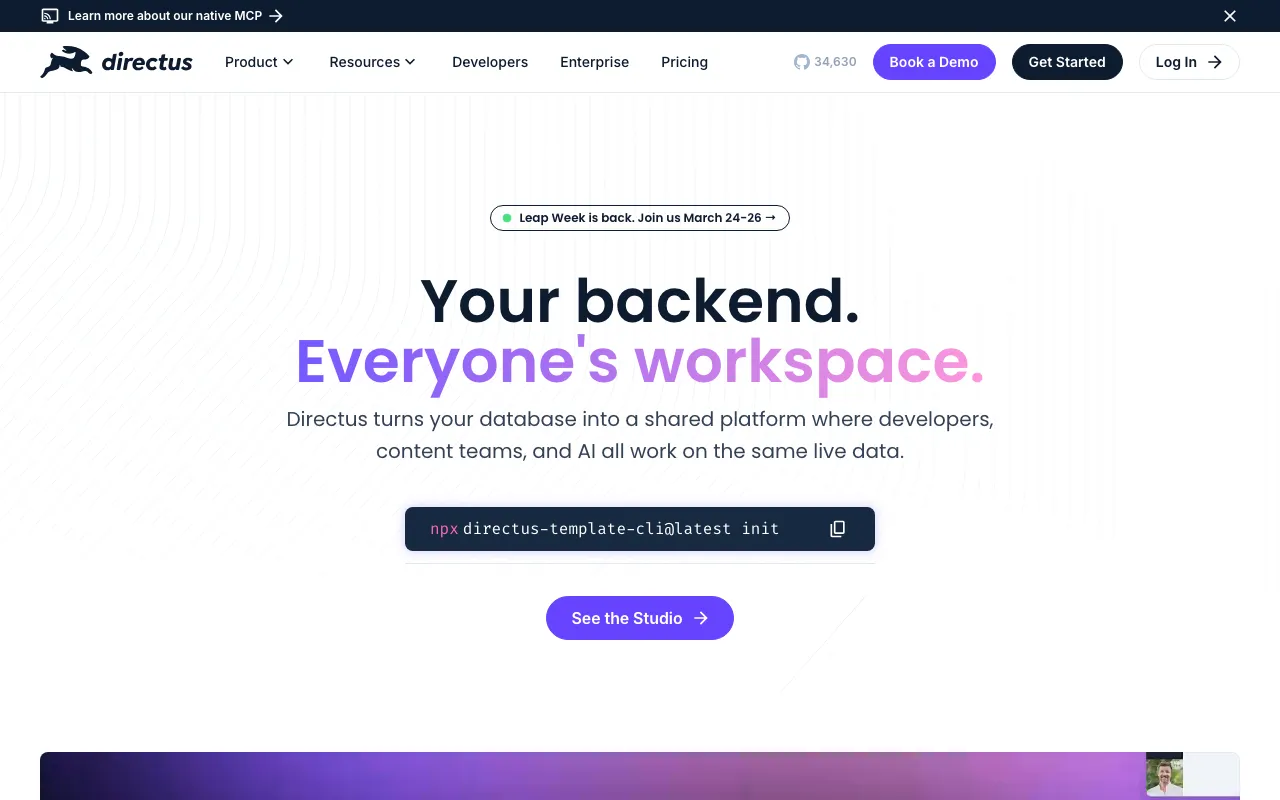
Directus is an open-source data platform that takes a database-first approach — instead of forcing a specific data model, it wraps your existing SQL database and auto-generates REST and GraphQL APIs on top of it. This makes it a compelling alternative to Strapi for teams that already have a database they want to expose via API.
- Features: Database-first architecture (PostgreSQL, MySQL, SQLite, and more), auto-generated REST + GraphQL APIs, visual workflow automation (Flows), granular policy-based permissions, real-time WebSocket support, JavaScript SDK, and over 34,000 GitHub stars
- Why You Should Use It: If you already have a database and want to build an API around it without being locked into a specific schema, Directus is the better choice. It also works great as a general-purpose Backend-as-a-Service, not just a CMS.
- Why Not: The cloud plan starts at $99/month — significantly higher than Strapi's Essential tier. It's also less opinionated, so pure CMS use cases require more manual configuration.
- Pricing: Fully open source and free to self-host. Directus Cloud Professional starts at $99/month (5 users, 75k DB entries, 250k API requests/month).
We have a full guide on self-hosting Directus with Docker on Ubuntu if you want to run it on your own server.
2. Payload CMS
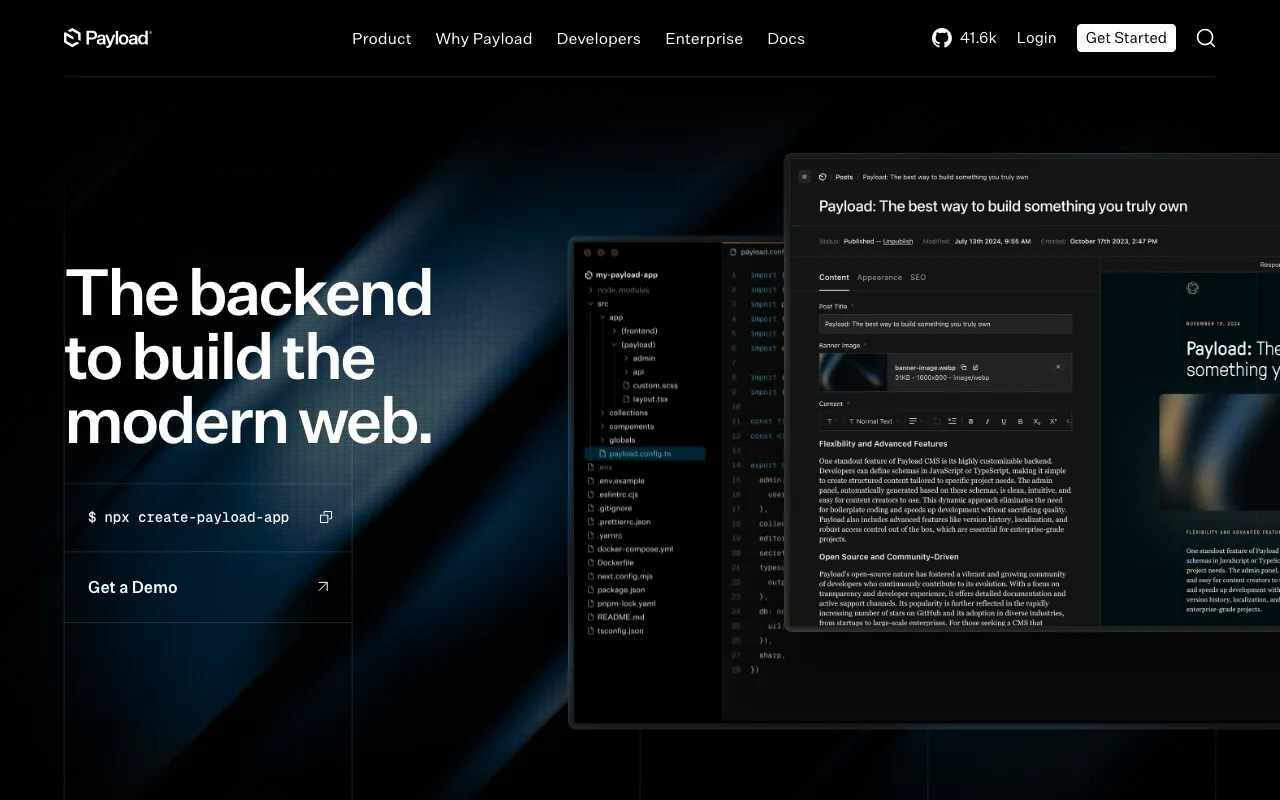
Payload CMS is a TypeScript-first, Next.js-native headless CMS that installs directly into your existing /app folder. Instead of running as a separate service, it lives inside your Next.js project and lets you query the database directly from React Server Components — no API layer needed.
- Features: Next.js-native integration, TypeScript-first with end-to-end type safety, Lexical rich text editor, versioning and drafts, localization, block-based layout builders, conditional field logic, granular access control, and serverless deployment support (Vercel, Cloudflare Workers)
- Why You Should Use It: If you're building a Next.js app and want your CMS to live directly in the same codebase, Payload is unmatched. There are no artificial API limits or SaaS fees — you only pay for your own infrastructure. The TypeScript-first approach also makes the developer experience significantly better than Strapi's.
- Why Not: It's tightly coupled to the Node.js/Next.js ecosystem, so it's not a good fit for non-JS stacks. The managed cloud hosting option is less mature than Strapi Cloud. Non-technical users may find it harder to configure without developer involvement.
- Pricing: Completely free and open source (MIT). Self-host on any platform — Vercel, Railway, Render, or a VPS. You only pay for your own infrastructure.
Check out our guide on how to run Payload CMS in Docker to get it running on your own server.
3. Sanity
Sanity takes a fundamentally different approach — instead of a traditional CMS, it's a "Content Lake": a real-time, cloud-hosted content database built for structured content delivery across multiple channels. Its fully customizable React-based editor (Sanity Studio) makes it a favorite for large editorial teams.
- Features: Real-time collaborative editing, GROQ query language for flexible content fetching, fully customizable React-based editor (Sanity Studio), AI-native architecture for LLM and agent integration, multi-channel content delivery, multiple datasets, and a generous free tier with 20 user seats
- Why You Should Use It: If you need powerful collaborative editing with a highly customizable interface, or you're building AI-native applications that need structured content, Sanity is the better fit. The free tier is extremely generous (20 users vs. Strapi's cold-start-only free plan).
- Why Not: It's fully cloud-hosted only — no self-hosting option — which means vendor lock-in. The GROQ query language has a learning curve. Costs scale per seat, which can get expensive for large teams. Private datasets require a paid plan.
- Pricing: Free forever (20 user seats, 10k documents, 1M CDN API requests). Growth starts at $15/seat/month. Enterprise pricing on request.
4. Storyblok
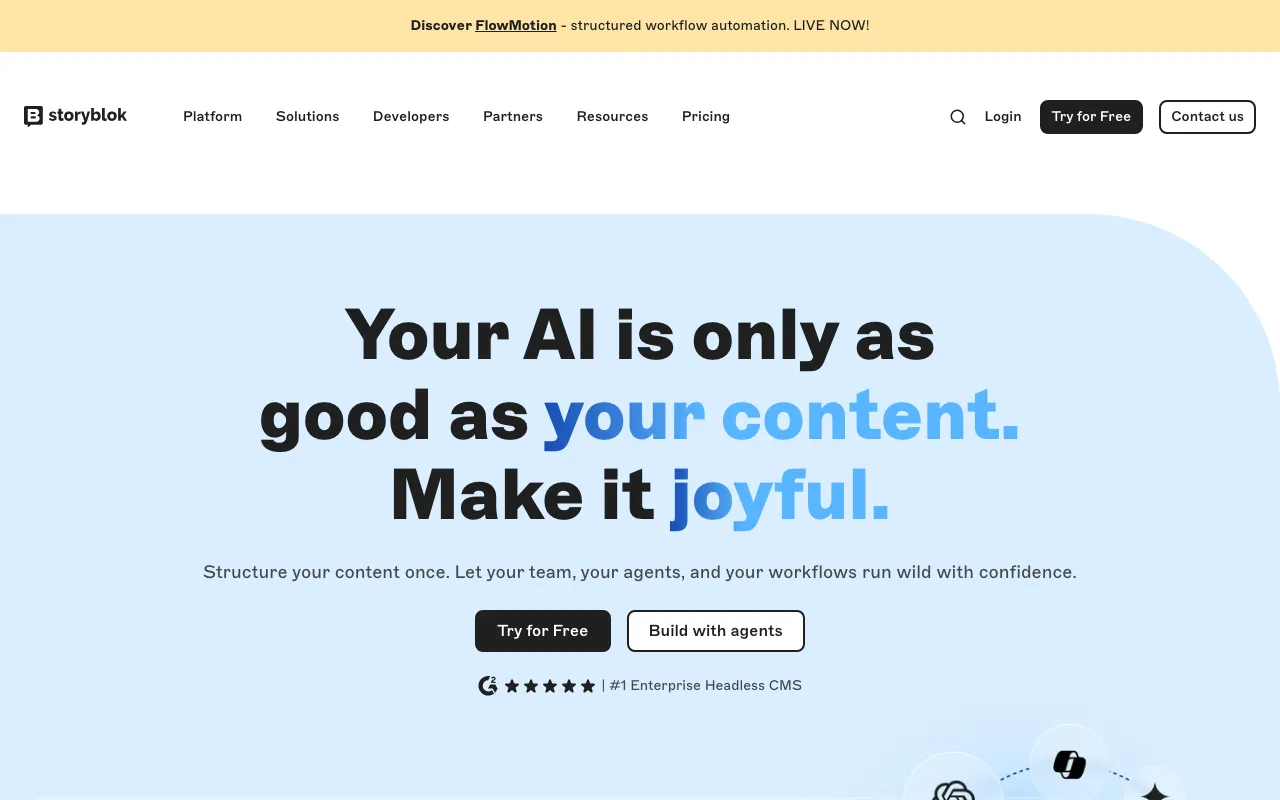
Storyblok is a headless CMS with a unique advantage: a visual editor with live, real-time preview. While Strapi is developer-focused with no visual preview, Storyblok lets marketers and content editors see exactly how their content looks as they edit it — a game-changer for component-based page building.
- Features: Visual editor with live preview, component-based "stories" architecture, REST and GraphQL APIs, built-in localization with AI-powered translation, 8,000+ integrations (Shopify, Slack, etc.), global CDN with auto-scaling, and enterprise-grade security (GDPR-compliant)
- Why You Should Use It: If your team includes non-technical content editors who need to work independently, Storyblok's visual editor is far ahead of Strapi's interface. It's also better for marketing sites where content editors need to build and rearrange page sections without developer help.
- Why Not: It's fully SaaS — no self-hosting option. The free tier is very limited (1 space, 100k API requests/month). GraphQL is only available on the Enterprise plan. Pricing jumps sharply from free to the Growth tier at $99/month.
- Pricing: Free forever (1 space, 1 user). Growth at $99/month (5 seats, 1M API requests, 400 GB traffic). Growth Plus at $349/month. Enterprise pricing on request.
5. Ghost
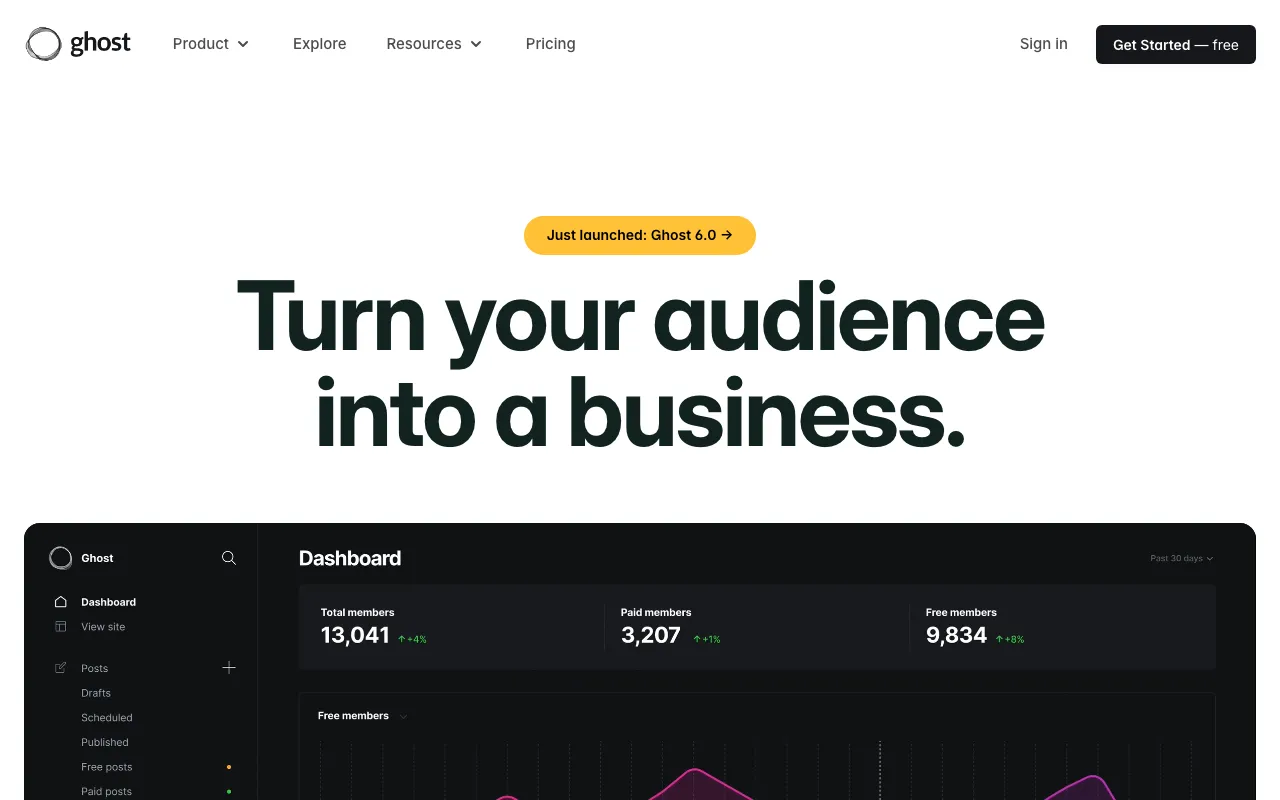
Ghost is an open-source CMS purpose-built for publishers, bloggers, and newsletter creators. Unlike Strapi's general-purpose API approach, Ghost is an all-in-one platform that combines content management with built-in membership management, paid subscriptions, and email newsletters.
- Features: Built-in membership and monetization with 0% transaction fees, integrated email newsletter system, headless JSON API for decoupled frontends, SEO-optimized out of the box, Lexical editor with rich media support, open source (MIT), and self-hostable
- Why You Should Use It: If you're building a publication, blog, or newsletter-based business, Ghost has everything built in. You don't need to wire up separate tools for email, memberships, or monetization. It's also much simpler to set up for non-developers than Strapi.
- Why Not: Ghost is highly opinionated — it's built for publishing, not general-purpose API backends or complex custom data models. Not suitable for ecommerce catalogs, app backends, or custom CMS schemas. Member limits on lower tiers can be restrictive for large audiences.
- Pricing: Free and open source (MIT). Ghost Pro managed hosting starts at $18/month (1 user, 1,000 members). Publisher at $29/month (3 users). Business at $199/month (15 users, 10k members).
We have a guide on deploying Ghost with Docker on Sliplane if you want to self-host it for less.
Conclusion
| Tool | Best For | Ease of Setup | Focus | Cloud Pricing |
|---|---|---|---|---|
| Strapi | Developers, custom REST/GraphQL APIs | Moderate | General-purpose headless CMS | From $18/mo |
| Directus | Database-wrapping, Backend-as-a-Service | Moderate | Data platform / headless CMS | From $99/mo |
| Payload CMS | Next.js developers, TypeScript-first projects | Easy (in Next.js) | Next.js-native headless CMS | Free (self-host only) |
| Sanity | Editorial teams, AI-native content | Easy | Cloud content platform | From $15/seat/mo |
| Storyblok | Marketing teams, visual page building | Easy | Visual headless CMS | From $99/mo |
| Ghost | Publishers, bloggers, newsletters | Very Easy | Publishing + membership platform | From $18/mo |
Each tool fills a different gap: Directus for database-wrapping, Payload CMS for Next.js projects, Sanity for collaborative editorial teams, Storyblok for visual editing, and Ghost for publishers and newsletter creators.
Strapi remains a great choice for developers who want a flexible, open-source headless CMS with a solid admin UI and REST/GraphQL API generation. But if your needs lean toward database-first architecture, Next.js integration, visual editing, or built-in publishing tools, one of these alternatives is likely the better fit.
Want to self-host one of these alternatives? Check out our guides:
- Self-hosting Directus with Docker on Ubuntu (for the Directus alternative)
- How to run Payload CMS in Docker (for the Payload CMS alternative)
- Deploy Ghost with Docker on Sliplane (for the Ghost alternative)